What does a realistic budget include (and what is often missing)?
The full scope of costs required to complete a residential project
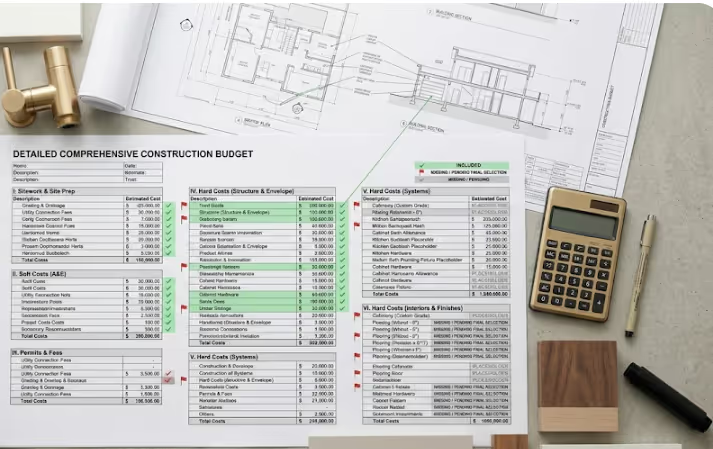
A realistic construction budget includes all costs required to complete the project, not just the visible building work. This means accounting for design, permitting, site conditions, allowances, and ongoing changes, not just materials and labor.
Budgets often fall short because they exclude or underestimate categories that are less obvious early in the process. These gaps can lead to significant cost increases as the project becomes more defined.
In this article
- What a complete construction budget should include
- Which categories are commonly overlooked
- Why early budgets often feel lower than final cost
- How to evaluate whether a budget is truly complete
Context
Most homeowners approach budgeting with a focus on the visible outcome of the project. Kitchens, bathrooms, finishes, and overall square footage tend to dominate early conversations. While these are important, they represent only part of the total cost.
Construction projects involve a wide range of supporting work that is not always obvious in early discussions. Permits, engineering, site preparation, coordination, supervision, and temporary conditions all contribute to the final number.
The challenge is that early budgets often rely on partial information. Without a structured approach, it is easy for key categories to be excluded, underestimated, or grouped into broad assumptions that do not reflect actual cost.
The short answer
A realistic budget includes hard construction costs, soft costs, general conditions, allowances, and contingency-related items tied to uncertainty.
Budgets that appear lower often exclude or understate one or more of these categories. The result is not necessarily a cheaper project, but a less complete picture of the total cost required to finish the work.
The goal is not to eliminate uncertainty, but to make it visible and manageable within the budget structure.
What a complete budget includes
A comprehensive budget is structured to capture all phases of the project, from early planning through final completion. This includes both direct construction costs and the supporting costs required to make the work possible.
Hard costs are typically the most visible. These include labor, materials, subcontractor work, and the physical construction of the project. However, they are only one part of the total.
Soft costs and general conditions are equally important. These include design fees, permits, insurance, temporary facilities, and project management. These costs are necessary to execute the project but are often overlooked in simplified estimates.
- Hard construction costs: Labor, materials, subcontractors, and physical building work.
- Soft costs: Architectural design, engineering, permits, and professional services.
- General conditions: Site setup, dumpsters, temporary utilities, supervision, and coordination.
- Allowances: Placeholder values for selections not yet finalized.
- Contingency and unknowns: Items tied to incomplete information or unforeseen conditions.
What is often missing
Missing costs are rarely intentional. They typically result from incomplete information, assumptions, or an effort to simplify the budget presentation. However, these omissions can have a significant impact as the project progresses.
One common gap is soft costs. Homeowners may focus on construction pricing while underestimating the cost of design, engineering, and permitting. These services are essential and can represent a meaningful portion of the overall budget.
Another frequent omission is general conditions. Items like site protection, waste removal, temporary facilities, and project supervision are necessary but not always visible in simplified estimates.
Allowances are another source of hidden risk. When placeholder numbers are too low or too broad, they can make a budget appear complete while still carrying significant future cost movement.
- Design and engineering fees: Often excluded or underestimated in early budgets.
- Permits and approvals: Costs vary by municipality and project scope.
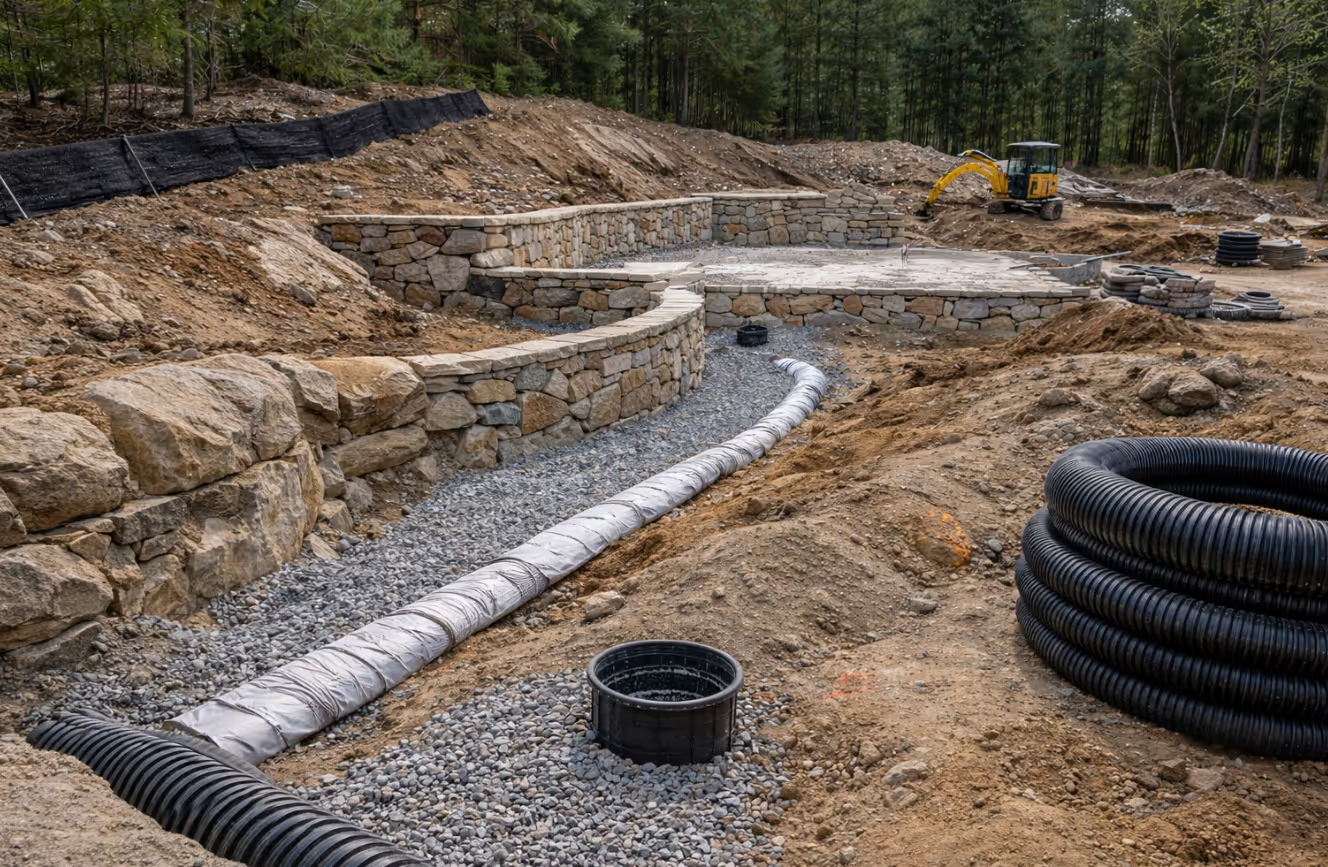
- Site and existing conditions: Excavation, utilities, and unforeseen conditions can add cost.
- Temporary and support work: Site setup, protection, and logistics are required but often overlooked.
- Unrealistic allowances: Placeholder values that do not match the intended finish level.
Why early budgets feel lower
Early budgets often feel more affordable because they are based on incomplete information. At the conceptual stage, many decisions have not yet been made, and assumptions are used to fill gaps.
As the project progresses, those assumptions are replaced with real selections, subcontractor bids, and detailed scopes of work. This typically increases accuracy, but it can also increase cost if the original assumptions were optimistic.
This is a normal part of the process, not a failure. The key is to understand that early numbers are directional, while later estimates are more definitive.
Problems arise when early budgets are treated as fixed commitments rather than evolving tools. Without recognizing this progression, cost increases can feel unexpected even when they are a natural result of better information.
How to evaluate a budget
Evaluating a budget requires looking beyond the total number and understanding how it is built. A complete budget should clearly define what is included, what is excluded, and what is still uncertain.
Clarity in structure is essential. Costs should be broken down into categories with clear descriptions, rather than grouped into broad totals. This allows for better comparison and more informed decision-making.
It is also important to identify allowances and estimated values. These should be clearly labeled so it is easy to understand where the budget may still change.
Finally, consider how the budget will evolve. A strong process includes updates as selections are made, bids are received, and conditions are confirmed. This ongoing refinement is what turns an early estimate into a reliable financial plan.
- Scope clarity: Each category should describe what is actually included.
- Transparency: Assumptions, allowances, and exclusions should be visible.
- Level of detail: More detailed budgets are generally more reliable.
- Update process: The budget should evolve as the project becomes more defined.
The Clarity perspective: how Clarity Building Group handles this
At Clarity, budgets are built to reflect the full scope of the project from the beginning, even when some elements are still developing. Early conceptual budgets include both hard and soft costs, along with realistic allowances based on past projects .
During preconstruction, the focus shifts to replacing assumptions with actual numbers. Subcontractor bids, vendor pricing, and defined scopes of work are incorporated into a detailed control estimate that improves accuracy and transparency.
Multiple trade bids are used to validate pricing and ensure that each category reflects current market conditions. This reduces the risk of missing or underestimated costs.
Ongoing budget tracking continues through construction. Monthly updates show committed costs, remaining scope, and projected final cost, allowing homeowners to see how decisions and changes impact the overall budget in real time .