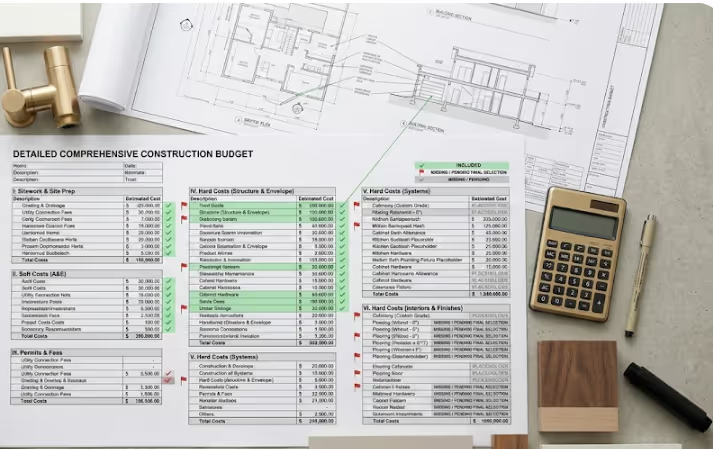
How allowances work and why they can distort your budget
The hidden risks behind placeholder numbers in construction estimates

Allowances are placeholder amounts used when a product, scope item, or level of finish has not been fully defined yet. They are common in early construction budgeting, but they are not fixed prices, and they should never be mistaken for final cost.
The risk is not that allowances are inherently wrong. The risk is that they can make a budget appear more complete and more stable than it really is. When actual selections, field conditions, or trade pricing replace those placeholders, the total cost can move significantly.
In this article
- What an allowance is and why builders use it
- Why allowances often create false confidence in an early estimate
- Which categories are most likely to change
- How to reduce allowance risk before construction starts
Context
Most homeowners first encounter allowances in an early budget, not in a fully developed construction price. At that stage, drawings may still be evolving, product selections may be incomplete, and subcontractor bids may not yet be in hand. A placeholder is often the only practical way to carry a number.
That is not automatically a problem. In fact, early budgeting often requires reasonable assumptions so a team can test feasibility and make decisions. The problem starts when allowances are treated as though they are locked numbers rather than temporary placeholders tied to incomplete information.
In architect-led residential work, allowances tend to appear where design detail, product quality, installation complexity, or owner preference can vary widely. A powder room vanity, tile package, appliance suite, decorative lighting package, or custom millwork item can all land in a very different place once real selections are made.
The short answer
Allowances are budget placeholders for items that are not fully specified yet. They help move planning forward, but they are not the same as actual committed cost.
They distort budgets when the placeholder is too low, too broad, or disconnected from the actual design intent. A budget with many unresolved allowances may look financially workable on paper while still carrying substantial future cost risk.
That is why the right question is not whether a budget includes allowances. The better question is how many there are, how realistic they are, and what process exists to replace them with actual numbers before construction is too far along.
Why this happens
Allowances exist because construction planning often starts before every decision has been made. A homeowner may know they want a new bathroom, kitchen, or addition, but not yet know the exact plumbing fixtures, cabinet construction, tile selections, or lighting package. The builder still needs a way to include those categories in a working budget.
In a conceptual budget, those placeholders are often based on past project data, typical local pricing, or a range of quality assumptions. That can be useful for early planning. But there is still a meaningful difference between a historical placeholder and a current subcontractor proposal tied to a defined scope.
Allowances also persist when design documents do not fully define the work. If a drawing shows a bathroom layout but does not specify tile material, fixture model, trim level, installation pattern, or accessory requirements, the estimate may carry an allowance rather than a true procurement number.
- Early budgeting need: A placeholder lets the team evaluate overall feasibility before every product is selected.
- Incomplete information: Missing details in drawings or specifications force assumptions into the estimate.
- Wide quality range: Some categories have a very large spread between basic, premium, and custom options.
- Installation unknowns: Even when product pricing seems straightforward, labor and support work may vary.
Common causes
The most common cause of allowance distortion is an unrealistic placeholder. Sometimes the number is simply too low for the level of home being designed. A builder may include an appliance, tile, or cabinetry allowance that technically fills the budget category, but does not reflect the quality level the client actually expects.
A second cause is lumping too much uncertainty into one broad category. For example, a single allowance for kitchen cabinetry may hide differences in box construction, door style, finish system, hardware quality, interior accessories, and installation complexity. The category is present, but the real scope is still undefined.
A third cause is assuming product cost without accounting for the full installed cost. Homeowners naturally focus on visible selections, but the final number may also include freight, delivery coordination, trim-out parts, substrate preparation, specialty installation, supervision, and waste factors.
A fourth cause is timing. The longer an allowance remains unresolved, the more likely it is that the project moves forward while carrying budget uncertainty. Once framing, rough-ins, or fabrication schedules are underway, replacing placeholders with actual numbers can become more urgent and more consequential.
- Low placeholder values: The number fits the spreadsheet but not the actual expected finish level.
- Broad undefined scope: One line item may hide many unresolved decisions.
- Missing labor or accessories: Product allowances often understate the real installed cost.
- Delayed selections: Waiting too long keeps uncertainty in the budget and can affect scheduling.
How to reduce risk
The first way to reduce allowance risk is to identify it clearly. A budget should distinguish between hard numbers, quoted subcontract values, estimated costs, and allowances. When all cost lines look equally certain, homeowners can easily overestimate how stable the budget really is.
The second is to match allowance values to the design intent. If the home is aiming for custom windows, premium plumbing fixtures, detailed millwork, and architect-driven finish selections, the allowances should reflect that level. Placeholder numbers should be honest enough to support real decision-making, even if they still carry uncertainty.
The third is to make key selections earlier. The earlier cabinetry, windows, tile, plumbing fixtures, appliances, lighting, and finish details are defined, the sooner placeholder values can be replaced with actual trade pricing and purchase numbers. That improves both budget accuracy and schedule reliability.
The fourth is to move from conceptual pricing to a control estimate before construction begins in earnest. That stage matters because it replaces many assumptions with current subcontractor bids, detailed scopes of work, and real vendor pricing. The budget becomes less theoretical and more operational.
- Separate placeholders from firm pricing: The user of the budget should know which numbers are still provisional.
- Align allowances with expected quality: Placeholder values should fit the project, not just keep the total low.
- Finalize selections earlier: Design clarity reduces both cost variance and schedule pressure.
- Update the budget continuously: Each selection and subcontract award should reduce uncertainty over time.
What to look for early
Early warning signs are usually visible in the structure of the estimate itself. If major finish categories are carried as broad allowances, or if large parts of the scope are described only in general terms, the budget may still be useful for planning but should not be treated as a prediction of final cost.
Another sign is when the allowance seems disconnected from the home itself. A highly customized renovation or architect-led addition typically involves more variation in products, detailing, and coordination than a more standardized project. The estimate should acknowledge that reality instead of flattening it.
Watch for categories where owner taste drives cost. Kitchens, tile, plumbing fixtures, vanities, decorative lighting, built-ins, hardware, and specialty finishes often move once selections begin. That does not mean those categories are out of control. It means they should be handled with more transparency and more attention.
It is also worth paying attention to whether the team has a defined process for replacing allowances. If there is no clear path from early placeholders to trade bids, vendor quotes, approved selections, and ongoing budget updates, the estimate may remain unstable longer than it should.
The Clarity perspective: how Clarity Building Group handles this
At Clarity, allowances are treated as a temporary planning tool, not as a substitute for cost control. In preconstruction, early budget numbers may rely on historical cost data where decisions are still open, but those placeholders are expected to be tested and refined as the design develops.
Budget transparency matters here. The goal is to show which numbers are based on actual subcontractor bids or vendor pricing and which numbers still depend on unresolved selections or scope definition. That distinction helps homeowners understand where the budget is solid and where it still carries movement.
As the project advances, multiple trade bids help replace broad assumptions with current market pricing tied to a defined scope of work. That is one of the key differences between an early conceptual budget and a more reliable control estimate.
Ongoing tracking also matters after the estimate is approved. As selections are finalized, contracts are committed, and changes are considered, the budget should be updated in a way that shows original scope, approved changes, proposed ideas, and predicted final cost. That is how placeholder uncertainty gets reduced over time rather than hidden.