The hidden risks of many allowances in construction budgets
Why placeholder numbers create uncertainty
Allowances are a common part of construction budgets, but they are also one of the most misunderstood. While they can be useful early in the process, they introduce uncertainty that can significantly affect final cost.
The more allowances a budget contains, the less defined the project is. This creates a gap between the initial estimate and what the project will actually cost to complete.
In this article
- What allowances are and why they are used
- How they create budget uncertainty
- Where risks typically appear
- How to reduce reliance on allowances
Context
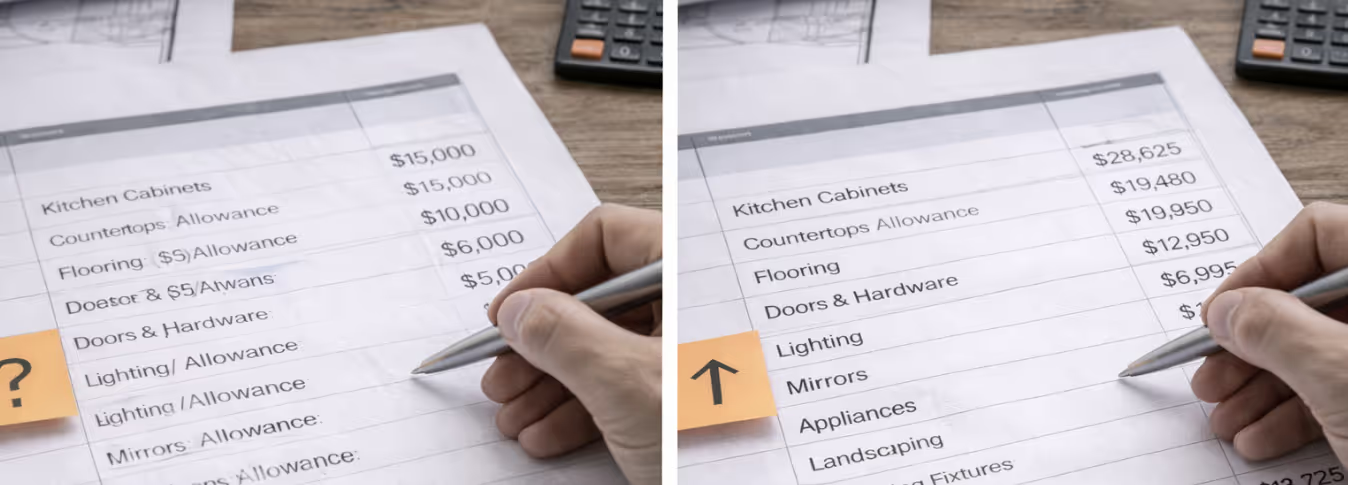
Allowances are typically used when selections or details have not yet been finalized. They act as placeholder numbers so that a budget can be created before every decision is made.
This is a practical necessity in early design phases. However, problems arise when allowances are used extensively or without clear understanding.
At that point, the budget becomes less of a defined cost and more of a projection based on assumptions.
The short answer
Allowances replace real scope with estimated values, which creates uncertainty in the budget.
When actual selections are made, costs often differ from the allowance, leading to increases.
The more allowances in a budget, the greater the risk of overruns.
Why this happens
Allowances exist because not all decisions are made at the time of estimating. Items such as fixtures, finishes, and specialty components may still be undefined.
Builders must include a number to represent these items. That number may be based on past experience, general expectations, or strategic considerations.
Different builders may approach allowances differently. Some include realistic values, while others may use lower numbers to make the overall budget appear more competitive.
This creates variation and uncertainty from the start.
- Undefined selections: Items not yet chosen.
- Estimated values: Based on assumptions rather than decisions.
- Builder strategy: Allowances may be optimistic or realistic.
- Inconsistent approaches: Different builders use different standards.
Where risks show up
Allowances most commonly affect categories with a wide range of possible costs. These include finishes, cabinetry, appliances, and specialty systems.
The difference between a basic and high-end selection in these categories can be substantial. If the allowance does not match the homeowner's expectations, the budget will shift.
These changes often occur during construction, when selections are finalized and actual costs are known.
At that point, adjustments are no longer theoretical. They directly impact the project budget.
- Finishes: Tile, flooring, and paint selections.
- Fixtures: Plumbing and lighting choices.
- Millwork: Cabinetry and custom built-ins.
- Appliances: Wide range of pricing options.
What this means in practice
A budget with many allowances may appear complete, but it does not represent a fixed or fully defined cost. It reflects a range of possible outcomes.
As selections are made, each allowance is replaced with an actual cost. If those costs are higher than the placeholders, the budget increases.
These increases can feel incremental at first, but they often accumulate over time.
By the end of the project, the total difference can be significant.
- Incremental increases: Small differences add up.
- Late visibility: Costs become clear during construction.
- Budget drift: Gradual movement away from original estimate.
- Reduced predictability: Harder to forecast final cost.
Common mistakes
A common mistake is assuming that allowances are accurate representations of final cost. In reality, they are placeholders that may or may not align with actual selections.
Another issue is focusing on the total budget without examining how much of it is made up of allowances. A lower total with many allowances may be less reliable than a higher, more defined estimate.
Some projects also defer too many decisions, increasing reliance on allowances and pushing cost clarity into construction.
These patterns increase the likelihood of overruns.
- Assuming accuracy: Treating allowances as fixed costs.
- Ignoring composition: Not reviewing how much is allowance-based.
- Deferred decisions: Increasing reliance on placeholders.
- Comparing totals only: Missing underlying differences.
What to ask before moving forward
Homeowners should ask which items in the budget are allowances and how those values were determined. Understanding the basis of these numbers is critical.
It is also important to evaluate whether the allowances align with your expectations for quality and finish level.
Ask how differences between allowances and actual costs will be tracked and communicated during the project.
Reducing the number of allowances before construction begins improves cost certainty.
The Clarity perspective: how Clarity Building Group handles this
At Clarity, allowances are minimized through a detailed preconstruction process. Selections and scope are developed early so that subcontractors can provide real pricing.
Where allowances are necessary, they are based on realistic expectations and clearly identified. This ensures that homeowners understand where uncertainty remains.
As the project progresses, allowances are replaced with actual costs through a structured change and budget tracking process.
This approach reduces uncertainty and helps maintain control over the final project cost.