How site conditions impact design and cost
Understanding soil, grading, and constraints
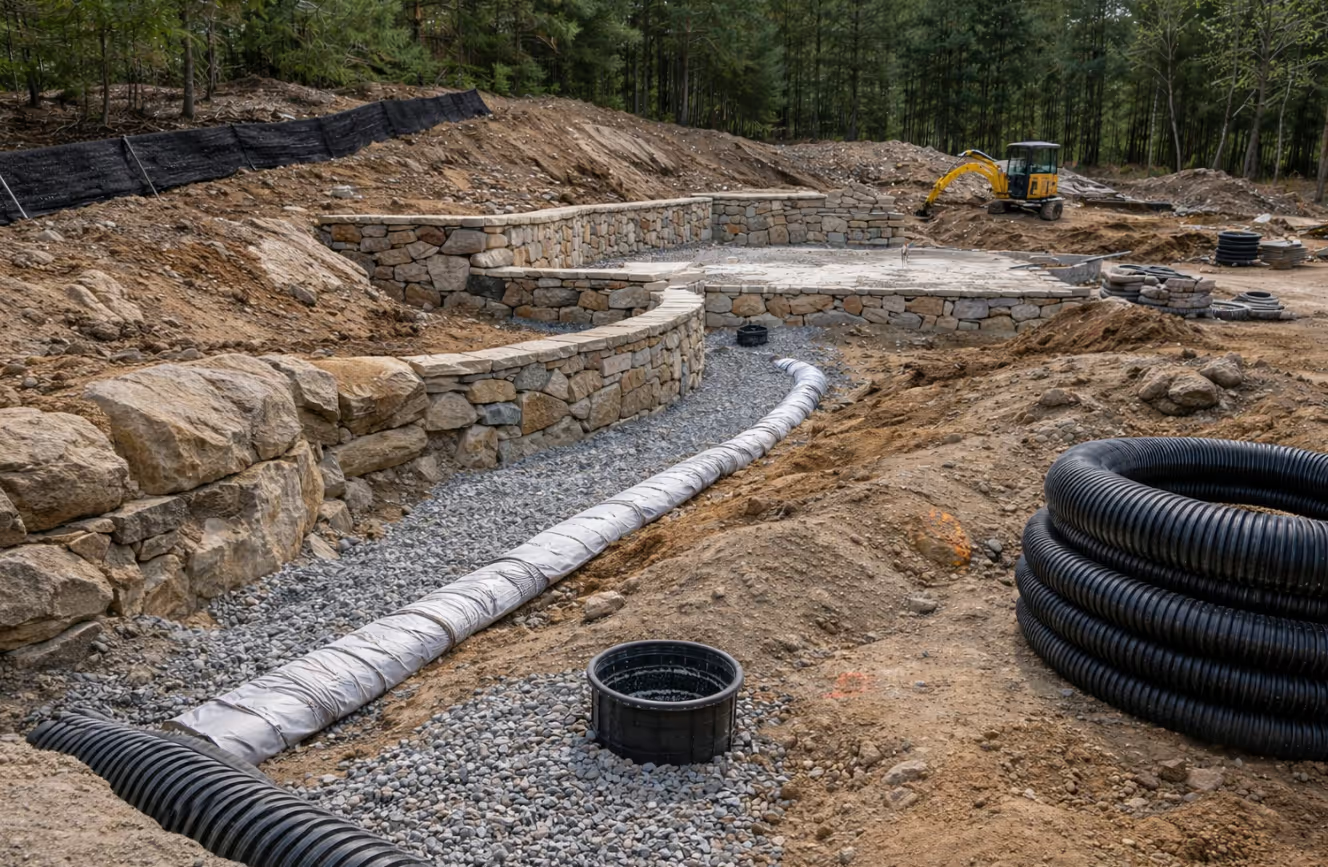
Site conditions are one of the most significant and least visible drivers of cost in residential construction. Two identical house designs can have very different costs depending on what is happening below the surface and across the site.
Factors like rock, soil stability, drainage, and existing site constraints often introduce complexity that cannot be fully understood until design and preconstruction work is underway.
In this article
- How subsurface conditions affect cost
- Site constraints in older communities
- Grading, slopes, and access challenges
- Stormwater and regulatory impacts
- How to plan for uncertainty
Many homeowners assume their project cost is primarily driven by the house itself. In reality, the site can introduce equal or greater variability.
This is especially true in established Main Line communities, where properties often have decades of prior development, unknown subsurface conditions, and tight zoning constraints.
Understanding these factors early helps avoid surprises and allows for more informed design decisions.
The short answer
Site conditions impact cost by introducing uncertainty, additional labor, specialized engineering, and regulatory requirements. These factors are often not fully known at the beginning of a project.
As a result, early budgets must account for variability, and detailed investigation during preconstruction is critical to gaining control.
What drives the outcome
Several site-related factors consistently influence both cost and design decisions. Some are visible, while others are only discovered during excavation.
- Subsurface conditions: Rock, poor soils, or high groundwater can require specialized excavation, structural support, or drainage systems.
- Existing hazards: Oil tanks, buried debris, and undocumented utilities are common in older neighborhoods and can require removal and environmental remediation.
- Topography: Steep slopes increase the need for retaining walls, structural foundations, and complex grading.
- Access limitations: Narrow lots or long driveways affect how materials and equipment reach the site.
- Regulatory requirements: Stormwater management and impervious coverage limits can significantly alter site design.
Each of these variables can shift both the scope of work and the sequence of construction.
What this means in practice
Subsurface conditions are often the most unpredictable. Excavation may reveal rock that requires hammering or blasting, or unstable soils that need to be removed and replaced.
In older communities, it is also common to encounter buried oil tanks or abandoned infrastructure. These discoveries require proper handling, which adds both cost and time.
Site slope introduces another layer of complexity. A flat site allows for straightforward foundations and drainage. A steep site may require:
- Retaining walls: Structural systems to hold back soil and create usable space
- Step foundations: More complex concrete work that follows the grade
- Drainage systems: Additional measures to manage water movement across the site
Access also plays a role. Long driveways increase paving costs and often trigger additional stormwater requirements because they add impervious surface area. This can lead to the need for underground infiltration systems or rain gardens.
Stormwater management is increasingly a major driver. Municipal regulations require that new impervious surfaces be offset with systems that manage runoff. Soil percolation rates determine whether water can be absorbed on site or requires more complex solutions.
Common mistakes
Site-related risks are often underestimated or overlooked entirely in early planning. This leads to unrealistic expectations and budget pressure later.
- Assuming all sites are equal: Comparing projects without considering site differences leads to misleading cost expectations.
- Underestimating unknowns: Early budgets that ignore subsurface risk often need significant adjustment later.
- Overlooking regulatory impact: Stormwater and zoning constraints can reshape the design in meaningful ways.
- Ignoring access challenges: Long or difficult driveways add both direct cost and indirect complexity.
These issues are not unusual. They are a normal part of building in established areas, but they need to be acknowledged and planned for.
What to ask before moving forward
Before committing to a design or budget, it is important to understand how much is known about the site and what remains uncertain.
- What site investigations have been completed: Soil testing, surveys, and utility locating
- What risks remain unknown: Areas where assumptions are being made
- How stormwater will be handled: Preliminary strategy based on site conditions
- How access affects construction: Equipment staging, driveway design, and logistics
These questions help establish whether the project is grounded in reality or still based on incomplete information.
The Clarity perspective: how Clarity Building Group handles this
Site conditions are addressed early and systematically during preconstruction. The goal is to reduce uncertainty before construction begins, not react to it later.
During the conceptual budgeting phase, allowances are made for typical site conditions based on experience. As the project progresses, more detailed investigation is performed to refine those assumptions.
In preconstruction, subcontractor input and site-specific analysis are used to build a Control Estimate based on real conditions. This includes obtaining multiple bids for excavation, foundation, and sitework to ensure accurate pricing.
Throughout construction, site-related costs are tracked and updated through ongoing budget reporting. This allows adjustments to be made transparently as conditions are confirmed in the field.
This process does not eliminate uncertainty, but it brings it into the open early and manages it with clear information and structured decision making.