What causes budget overruns and how they can be prevented
Identifying risk factors before they impact your project

Budget overruns in construction are rarely caused by a single issue. They are usually the result of multiple small gaps in planning, assumptions, or decision-making that compound over time.
The key to preventing overruns is not eliminating uncertainty entirely. It is identifying where uncertainty exists and managing it before construction begins and as the project progresses.
In this article
- The most common causes of budget overruns
- Why they often originate early in the process
- How to reduce risk before construction starts
- What to monitor during construction
Context
One of the most common concerns homeowners have is whether their project will stay on budget. This concern is valid, especially in custom residential construction where projects are unique and decisions evolve over time.
Budget overruns are often misunderstood as mistakes or mismanagement. In reality, many overruns are tied to how projects are planned and how information develops. Early assumptions, incomplete design, and evolving scope all play a role.
The difference between a controlled project and one that exceeds expectations is usually the level of transparency and process used to manage these factors.
The short answer
Budget overruns are typically caused by incomplete scope, unrealistic allowances, design changes, and unforeseen conditions.
They can be reduced by developing a detailed preconstruction process, aligning design with budget early, and maintaining ongoing cost tracking during construction.
Projects that treat the budget as a living document tend to perform more predictably than those that rely on a fixed early estimate.
Why this happens
Most overruns originate before construction begins. Early budgets often rely on assumptions because design decisions and site conditions are not fully defined. These assumptions can be reasonable, but they still carry uncertainty.
As the project develops, those assumptions are replaced with real selections, subcontractor bids, and field conditions. This increases accuracy, but it can also reveal that earlier numbers were optimistic or incomplete.
Another factor is the natural evolution of design. As homeowners and architects refine the project, new ideas and improvements are often introduced. These changes can increase cost if they are not balanced with budget considerations.
Finally, construction itself introduces variables. Existing conditions, coordination between trades, and material availability can all influence cost as work progresses.
- Early assumptions: Initial budgets are based on incomplete information.
- Design evolution: Refinements and additions can increase scope.
- Unforeseen conditions: Especially in renovation projects.
- Market factors: Labor and material pricing can shift over time.
Common causes
One of the most common causes of overruns is incomplete scope. When drawings or specifications do not fully define the work, estimates may rely on allowances or general assumptions. These placeholders are often replaced with higher actual costs once details are finalized.
Another frequent cause is unrealistic allowances. If placeholder values do not reflect the intended level of finish or complexity, the budget may appear lower than it should be.
Design changes are also a major factor. While some changes are expected, frequent or late-stage adjustments can increase both cost and schedule due to rework and coordination.
Site conditions can also contribute. Hidden issues such as structural challenges, utility conflicts, or soil conditions may not be fully understood until construction is underway.
- Incomplete drawings: Leads to assumptions rather than defined scope.
- Low allowances: Understates the true cost of selections.
- Scope changes: Adds cost as the project evolves.
- Existing conditions: Unknown factors discovered during construction.
How to reduce risk
The most effective way to reduce overruns is to invest in preconstruction. This phase focuses on developing detailed drawings, making key selections, and obtaining subcontractor bids before construction begins.
Aligning budget and design early is also critical. Regular cost feedback during design helps ensure that decisions are made with a clear understanding of their financial impact.
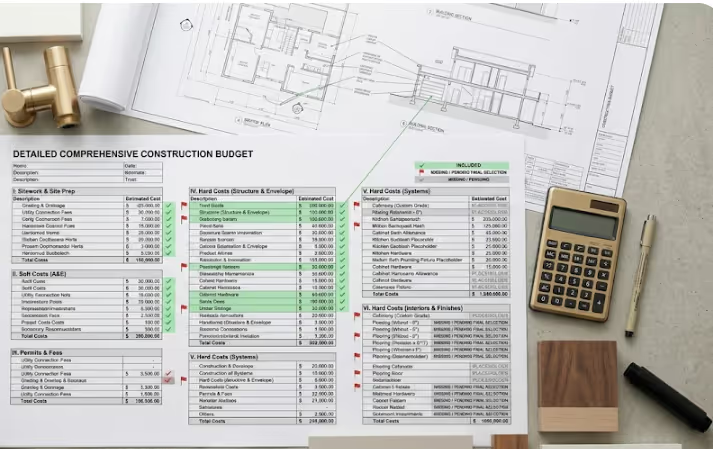
Transparency in budgeting is another key factor. Clear identification of allowances, assumptions, and exclusions allows homeowners to understand where the budget may still change.
Finally, a structured process for managing changes helps maintain control. Not all changes can be avoided, but they can be evaluated and tracked so their impact is understood.
- Detailed preconstruction: Reduces reliance on assumptions.
- Early selections: Replaces allowances with actual pricing.
- Clear documentation: Defines scope and reduces ambiguity.
- Change management: Tracks and evaluates cost impact.
What to look for early
Early warning signs of potential overruns often appear in the structure of the budget. A high number of allowances or broadly defined categories may indicate that significant decisions are still unresolved.
Another sign is a lack of detail in the estimate. If costs are grouped into large categories without clear scope descriptions, it can be difficult to understand what is included.
Misalignment between design and budget is also a risk factor. If the design assumes a level of complexity or finish that is not reflected in the budget, adjustments will be required later.
Finally, consider whether there is a clear process for updating the budget. Without ongoing tracking, it is difficult to manage changes and maintain visibility into final cost.
The Clarity perspective: how Clarity Building Group handles this
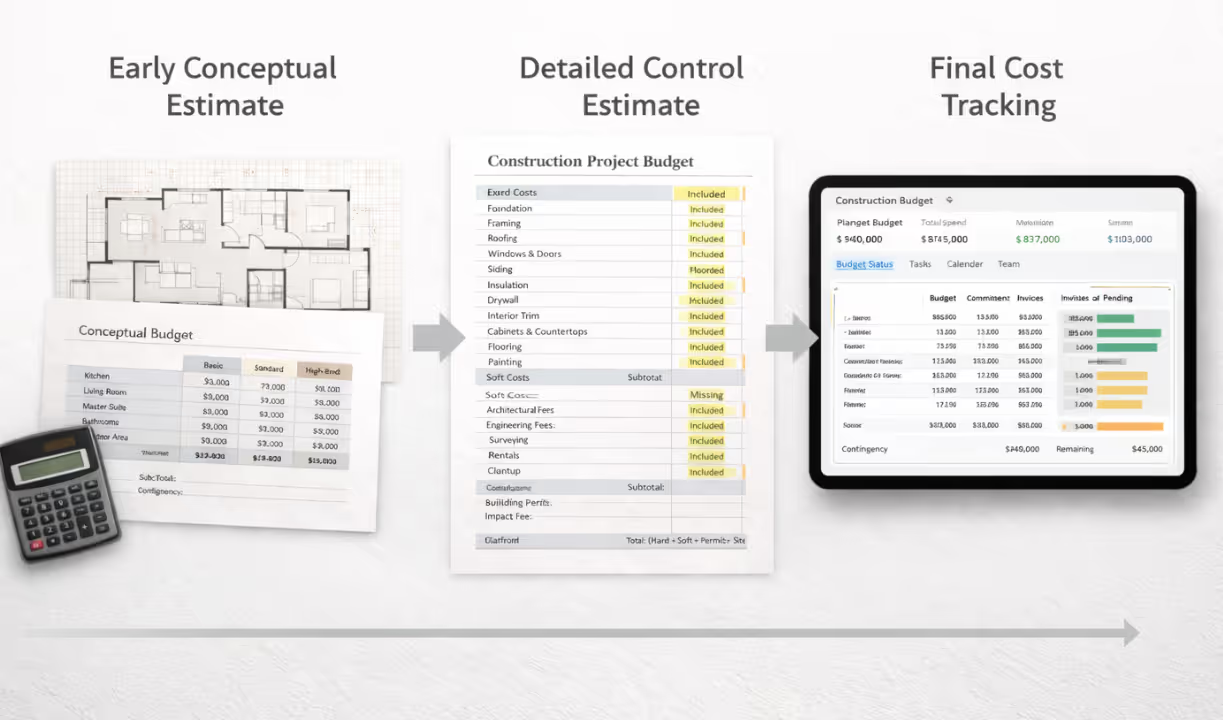
At Clarity, preventing budget overruns starts in preconstruction. Early conceptual budgets are used to establish direction, but they are refined through detailed design development and subcontractor bidding.
Budget transparency is central to this process. Allowances, assumptions, and defined costs are clearly identified so homeowners understand where uncertainty exists.
Multiple trade bids are obtained to validate pricing and reduce the risk of missing or underestimated costs. This helps transition from a preliminary budget to a more reliable control estimate.
During construction, ongoing budget tracking provides continuous visibility. Monthly updates show committed costs, remaining scope, and projected final cost, allowing issues to be identified and addressed early rather than after they impact the overall budget .