Why serious residential projects use cost-plus contracts
Why complex projects require a different pricing structure
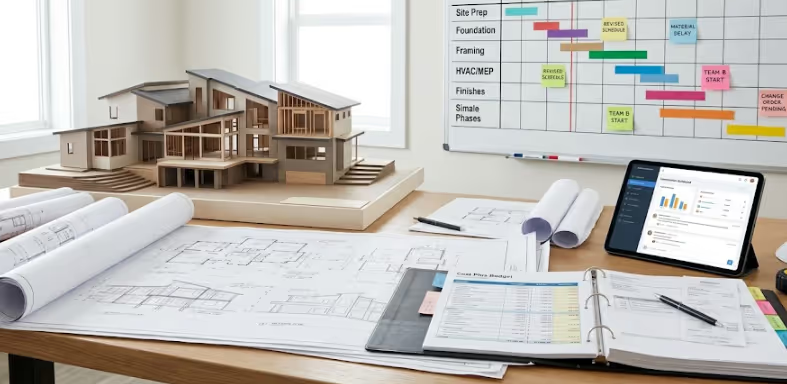
Serious residential projects often use cost-plus contracts because they reflect how custom construction actually works. These projects involve evolving design, detailed coordination, and conditions that cannot always be fully defined upfront.
Rather than forcing a fixed number too early, cost-plus allows the project to move forward with transparency and flexibility while maintaining financial control through structured tracking.
In this article
- Why fixed pricing struggles with complex projects
- What makes custom residential work different
- Where cost-plus provides advantages
- How to determine if it is the right fit
Context
In simpler construction projects, scope can often be fully defined before work begins. This allows builders to offer fixed pricing with a reasonable level of confidence.
Custom residential construction is different. Architect-led projects involve ongoing design decisions, unique details, and coordination between multiple trades. Many of these elements continue to develop during preconstruction and even into construction.
This creates a challenge for fixed pricing. Locking in a number too early often requires assumptions, contingencies, or simplified scope that may not reflect the final project.
The short answer
Cost-plus contracts are used because they align with the realities of complex, custom construction. They allow costs to reflect actual decisions, conditions, and market pricing as the project develops.
Fixed price contracts can work for well-defined, predictable projects, but they often struggle to accommodate the variability of high-end residential work.
The result is that cost-plus tends to provide better transparency and more accurate cost tracking for complex projects.
How these options differ
The core difference between cost-plus and fixed price is how risk and uncertainty are handled. Fixed price contracts require the builder to anticipate unknowns and include them in a single number.
In complex projects, this often leads to conservative assumptions, higher contingencies, or gaps in scope. The price may appear stable, but it may not fully reflect the actual work required.
Cost-plus takes a different approach. Instead of embedding uncertainty into a fixed number, it tracks actual costs as they occur. This allows the project to adapt as design decisions are made and conditions are confirmed.
This difference becomes more significant as project complexity increases.
- Fixed price: Requires early assumptions and embeds uncertainty into a single number.
- Cost-plus: Tracks actual costs and adjusts as the project develops.
- Risk handling: Fixed price shifts risk to the builder, cost-plus manages it transparently.
- Flexibility: Cost-plus allows design evolution without constant renegotiation.
Where each works best
Fixed price contracts work best when scope is clearly defined and unlikely to change. This is common in production housing or simpler projects with standardized details.
Cost-plus contracts are better suited to projects where design is evolving, scope is complex, or conditions are uncertain. This includes most custom homes and major renovations.
In these situations, flexibility and transparency become more valuable than locking in a number early.
Choosing the right structure depends on the nature of the project, not just the preference for a certain type of contract.
Where each breaks down
Fixed price contracts can break down when significant changes occur after the contract is signed. Adjustments often require change orders, which can add cost and create friction if not managed carefully.
They can also be less transparent. It may be difficult to see how individual costs are allocated or whether the price reflects current market conditions.
Cost-plus contracts can break down if there is a lack of structure or transparency. Without clear reporting and tracking, it can be difficult to maintain confidence in the process.
Both approaches require discipline, but the type of discipline is different.
- Fixed price limitations: Struggles with evolving scope and design changes.
- Change order pressure: Adjustments can become frequent and disruptive.
- Cost-plus risks: Requires strong tracking and communication.
- Process dependency: Success depends on how the contract is managed.
How to evaluate
To determine whether cost-plus is appropriate, consider the level of complexity in the project. The more unique the design, the more likely it is that scope will evolve.
Also consider how important transparency is. Cost-plus provides visibility into actual costs, which can be valuable for homeowners who want to understand and manage spending.
It is also important to evaluate the builder's process. Cost-plus requires detailed budgeting, clear documentation, and consistent reporting to be effective.
Finally, consider your own preferences. Some homeowners prefer the simplicity of a fixed number, while others value the flexibility and insight that cost-plus provides.
The Clarity perspective: how Clarity Building Group handles this
At Clarity, cost-plus is used because it aligns with the complexity of architect-led residential projects. The process begins with structured preconstruction, where budgets are developed and refined before construction begins.
Multiple subcontractor bids are obtained to replace assumptions with real pricing. This creates a strong financial foundation before work starts.
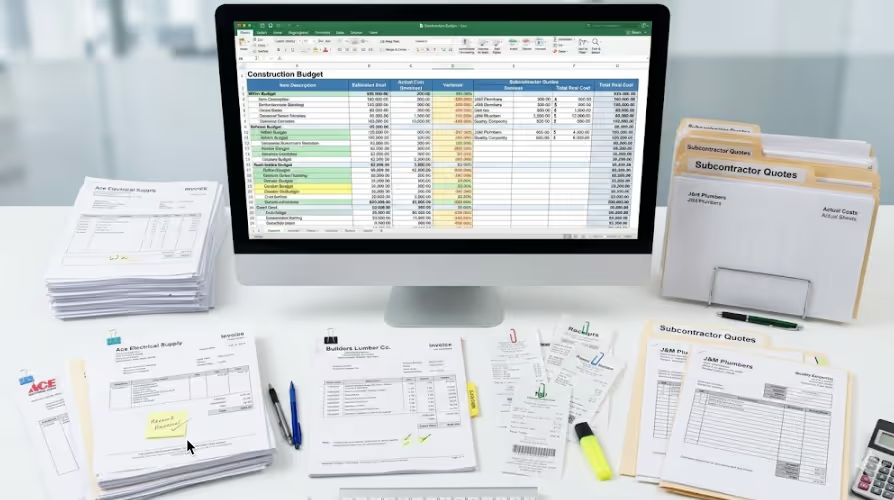
Transparency is maintained through open-book accounting, where homeowners can review invoices, receipts, and detailed budget reports .
Ongoing tracking continues through construction, with updates showing committed costs, remaining scope, and projected final cost. This allows the project to adapt while maintaining control over financial outcomes.